Vishal Vohra
 19 Mar 2026
For a long time, the process of loan recovery has been on the same path. If a borrower defaults their loan, the account is flagged, legal notices are sent, and the case slowly moves through arbitration or the courts. In practice, things that look organised on paper often turn out to be slow, costly, and hard to predict.
The primary concern isn’t just recovery. It is how disputes are resolved once they occur
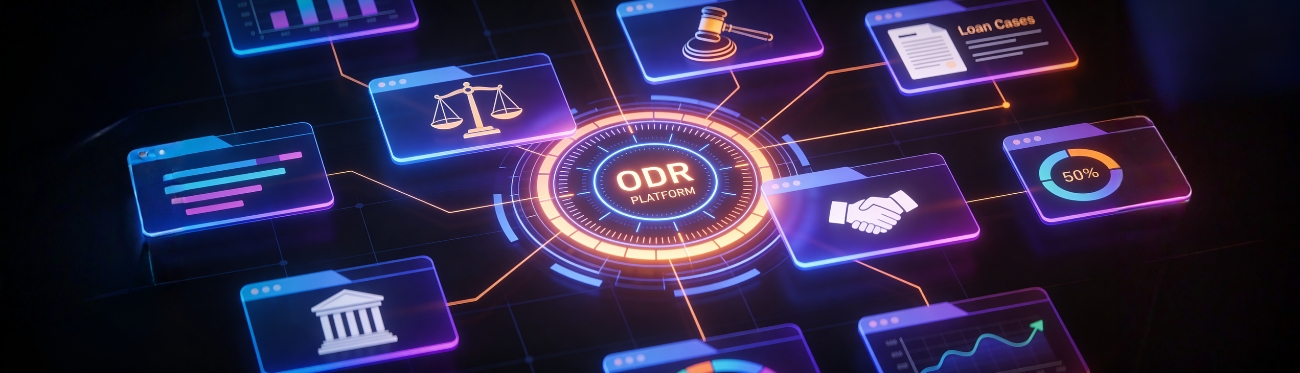
This is where an Online dispute resolution (ODR platform) is beginning to change the equation.
The Structural Gap in Loan Recovery
The banking and non-banking financial companies (NBFC) in India are dealing with an enormously growing amount of retail disputes. According to the Reserve Bank of India, the growth of digital lending and retail credit has led to a substantial increase in borrower oriented disputes that need to be resolved.
However, the infrastructure for resolving disputes has not grown as quickly.
Traditional recovery mechanisms continue to face structural constraints:
- Time delays: Arbitration and recovery proceedings often take 12–24 months, particularly when matters spill into courts
- Fragmented workflows: As noted in multiple industry discussions by NITI Aayog, dispute processes remain heavily manual and decentralised
- Low participation: Physical hearings and procedural complexity discourage borrower engagement
In its report on Online Dispute Resolution, NITI Aayog observed that traditional systems are “not designed for high-volume, low-value disputes,” which now dominate retail finance.
The result is a mismatch between modern lending scale and legacy dispute resolution systems.
The Cost of Delay: Revenue, Risk, and System Inefficiency
Delays in dispute resolution are not just procedural inefficiencies. They directly affect financial outcomes.
According to the World Bank, contract enforcement delays significantly increase the cost of recovery and reduce overall credit efficiency in financial systems.
For banks and NBFCs, this translates into:
- Higher NPAs: The probability of recovery declines sharply with time
- Capital lock-in: Funds remain tied up in unresolved disputes
- Escalating costs: Legal and administrative expenses increase with prolonged timelines
- Operational drag: Recovery teams spend time tracking cases rather than resolving them
Globally, studies on dispute resolution efficiency show that delays can increase recovery costs by 20–30%, especially in retail lending portfolios.
The effect is made stronger with regard to scale in India. When lakhs of cases pass through disorganised systems, even minor inefficiencies add up to substantial financial strain.
Why Financial Institutions Are Moving to ODR Platforms
Globally, financial systems have started to shift towards online dispute resolution platforms as a structural solution.
Countries like the UK and Singapore have incorporated digital dispute resolution into their systems for handling consumer and financial disputes. According to the Organisation for Economic Co-operation and Development, ODR systems are especially good at handling high volume disputes because they can cut down on expenditures, time, and procedural friction.
Typical outcomes observed across jurisdictions include:
- 50–70% reduction in resolution time
- Significant reduction in legal costs
- Higher user participation and compliance
India has also formally recognised this shift. The Reserve Bank of India and NITI Aayog have both encouraged the adoption of online dispute resolution for banks and NBFCs as part of broader digital finance reforms. The transition is no longer experimental. It is becoming a foundational requirement.
What an ODR Platform Changes in Loan Recovery
An ODR platform for loan recovery does not replace legal processes. It reorganises them into a structured, digital workflow.
Instead of fragmented and manual handling, the entire dispute lifecycle is managed on a single system:
- Digital case initiation
- Automated notice generation and delivery
- Online hearings
- Digital evidence submission
- Real-time tracking of awards and settlements
The impact is measurable.
Traditional arbitration timelines for a case involving a major NBFC portfolio were between 280 and 365 days. After implementing a digital debt recovery platform, cases were settled in 75 to 90 days, which reduced the time by up to 90%.
At the same time:
- Notice delivery improved from ~70% to over 99%
- Hearing participation increased by over 40%
- Arbitration costs reduced by nearly 90%
- Nearly 20% of cases were resolved early, even before full hearings
These are not incremental gains. They reflect a fundamental shift in how dispute resolution operates at scale.
How Jupitice is Enabling Digital Dispute Resolution at Scale
Jupitice has positioned itself as a global leader in building online dispute resolution ODR platforms for financial institutions.
Its approach focuses on managing the full dispute lifecycle rather than digitising isolated steps.
Through its platform:
- Cases are onboarded digitally in bulk
- Notices are issued instantly through automated systems
- Hearings are conducted online, removing logistical constraints
- Arbitrators are appointed quickly through structured panels
- Evidence and records are centrally managed
- Awards and settlements are generated and tracked in real time
For banks and NBFCs, this creates a fully integrated loan recovery dispute resolution system.
It also provides more visibility, which is far more crucial. Institutions can use real-time dashboards to keep track of performance, identify problems, and manage recovery outcomes on a large scale.
Disputes are no longer seen as separate legal events. They turn into structured operational processes.
The Net Impact: Faster Recovery, Lower Costs, Better Outcomes
The shift to a digital dispute resolution platform delivers impact across three dimensions:
- Recovery Efficiency
Faster resolution cycles improve recovery rates and reduce NPA ageing. - Cost Optimisation
Automation reduces legal and administrative costs significantly. - Customer Experience
Digital participation improves transparency, accessibility, and trust.
In high-volume lending environments, even minor improvements create significant financial outcomes. When resolution time reduces by 60–70%, the impact on liquidity, provisioning, and capital efficiency is quite substantial.
The Road Ahead
India’s financial system has already gone through a lot of digital transformations. Loans are processed faster, onboarding is done online, and money is sent out in minutes.
Now, settling disputes is catching up.
Banks and NBFCs that do a substantial amount of business in India have to implement online dispute resolution. It is becoming an essential element of the infrastructure.
The question is not if institutions should use an ODR platform.
It is how fast they can change.
In modern finance, recovery isn’t just about enforcing the rules. It’s all about being quick, clear, and efficient.
And progressively, digital systems are defining that.