Prerna Jagga
 01 Jun 2026

For years, legal departments in India have been managed through people, paperwork, emails, spreadsheets, and follow-ups.
It worked when legal workloads were limited. But in 2026, the reality is different.
Indian enterprises are dealing with growing litigation, tighter compliance, complex contracts, regulatory pressure, data privacy requirements, and faster business cycles. Legal teams are no longer expected to only “handle cases.” They are expected to protect business continuity, reduce risk, support growth, and deliver board-level visibility.
That is why the shift from legal management to legal intelligence is becoming a business priority.
Legal management System helps enterprises store and track legal work. Legal intelligence helps them understand, predict, automate, and act on it.
The Numbers That Should Keep Every GC Up at Night
Let’s start with the uncomfortable truth about India’s legal landscape — not in abstract terms, but in the concrete numbers that directly affect enterprise P&Ls.
- 55.8 Million Pending cases in Indian courts– as of March 2026
- 9 Years Average court disposal time nationally – 2025 projection
- 9.2% Annual enterprise revenue lost due to contract inefficiencies
- 79% / 58% Corporate law departments reporting increasing matter volumes with flat/shrinking budgets
- ₹22 Crore Average cost of a data breach in India in 2026 — directly tied to compliance gaps
These are not statistics from a policy paper. These are the operating conditions inside which every Indian enterprise’s legal team wakes up every morning.
And here’s the critical insight: legal management is how you survive these conditions. Legal intelligence is how you stop being defined by them.
The Five Real Pain Points Indian Enterprises Face Today
To understand what Legal Intelligence actually solves, we need to be honest about what Legal Management fails to address.
1. Contracts Are a Black Hole
The majority of Indian businesses are unaware of what is hidden in their contracts. Deadlines for renewals are missed. Liability caps are disregarded. Penalty provisions are not reported. Companies with inadequate contract visibility face three times as many compliance problems as those with organised contract management, according to research by the Aberdeen Group.
According to a World Commerce & Contracting survey, contract inefficiencies result in unmet commitments, incorrect billing, unclaimed credits, and penalty exposure, which cause businesses to lose an average of 9.2% of yearly income. That’s ₹46 crore that silently slips through the gaps in a spreadsheet each year for a business with ₹500 crore in revenue.
2. Litigation Has No Intelligence Layer
A mid-to-large Indian enterprise typically manages dozens — sometimes hundreds — of active litigation matters simultaneously, spread across forums, geographies, counsel, and internal departments. Most legal teams track these through email threads, shared folders, and periodic calls with outside counsel.
The result: no single view of exposure. No early warning on matters approaching critical dates. No pattern recognition across similar disputes. And no ability to report meaningfully to the board on aggregate legal risk without a manual audit that takes weeks.
Thomson Reuters’ Legal Operations Index (2024) confirmed that 67% of corporate law departments had flat-to-declining headcount even as matter volumes rose. You cannot solve a volume problem with a headcount solution.
3. Compliance Is Still a Calendar, Not a System
India’s regulatory environment has become dramatically more complex. The DPDP Act 2023. SEBI’s enhanced disclosure requirements. ESG reporting under BRSR. The Bharatiya Nyaya Sanhita replaces the IPC. GST audit trails. Labour code compliance across states.
Industry data for 2026 shows that the average cost of non-compliance for large Indian enterprises has risen 13% year-on-year, with data-related breaches averaging ₹22 crore per incident. Gartner notes that 40% of enterprise AI platforms will feature task-specific compliance agents by the end of 2026 — up from under 5% in 2025. Enterprises using manual compliance tracking are competing against themselves.
4. Legal Notices Are Treated as Admin, Not Strategy
Disputes start with legal notices. They are also the places where businesses covertly lose large sums of money.
Manual notice management for loan defaults and NPA recovery is a volume nightmare in the BFSI industry alone. The gross non-performing asset (NPA) ratio of public sector banks decreased from 9.11% in March 2021 to 2.58% in March 2025, a noteworthy accomplishment partially attributed to more focused early-stage legal action. However, the majority of businesses continue to write, send, and monitor legal notifications using email-based or paper-based procedures that lack version control, delivery confirmation, and connection to downstream dispute or case management.
5. Dispute Resolution Takes Years — and Costs a Fortune
With 55.8 million pending cases and a national average disposal time approaching 9 years, sending a commercial dispute into Indian courts is essentially freezing capital. It also consumes legal team bandwidth, creates uncertain balance sheet provisions, and generates a litigation risk overhang that sophisticated investors price into valuations.
Even formal arbitration — nominally faster — routinely takes 2–3 years in practice. For B2B disputes involving vendor contracts, lease agreements, service-level failures, or inter-company claims, enterprises need a faster path. One that is legally binding, enforceable, and doesn’t require years of back-and-forth across physical hearing rooms.
From Pain to Platform: How Jupitice Powers Legal Intelligence
Jupitice Justice Technologies is not a point solution. It is a Justice Operating System — a Meta Product Platform designed specifically for the legal, compliance, and dispute management needs of Indian enterprises, governments, and institutions.
Where traditional legal software gives you storage and workflow, Jupitice gives you visibility, prediction, automation, and resolution — across the entire legal lifecycle. Here is what that looks like in practice, across each pain point.
Jupitice Contract Lifecycle Management System (CLM)
Turn contracts from filing cabinets into strategic assets.
- AI-driven contract drafting, review, and clause-level risk flagging
- Automated renewal and obligation tracking — no missed deadlines
- Centralised contract repository with full version control and search
- Real-time alerts when clauses approach critical dates or thresholds
- Approval workflows configurable to your internal legal sign-off process
- Full audit trail for every contract action — board-ready at any moment
Jupitice Litigation Management System (LMS)
From reactive tracking to proactive litigation intelligence.
- Single dashboard view of all active matters across courts, forums, and geographies
- Automated case diary updates, hearing reminders, and deadline tracking
- Outside counsel management — tasks, fees, performance, and matter history
- AI-powered exposure analysis and risk scoring across your litigation portfolio
- Document management with evidence linking and court-submission-ready formatting
- Board-level reporting on aggregate legal exposure and matter status
Jupitice Compliance Management System (CMS)
Make compliance anticipatory, not reactive.
- Centralised legal register consolidating all statutory and regulatory obligations
- Saya AI engine — queries complex regulatory documents in plain language
- Automated task assignment, deadline tracking, and remediation workflows
- Predictive risk flagging for obligations approaching limitation periods
- 100% audit trail for every compliance action — regulator-ready documentation
- Sector-specific modules for BFSI, telecom, healthcare, manufacturing, and more
Jupitice Legal Notice Management System (LNMS)
Start dispute prevention where disputes actually begin.
- Automated legal notice drafting with pre-approved templates and version control
- Bulk notice generation and multi-channel dispatch — email, SMS, WhatsApp, portal
- Real-time delivery tracking and acknowledgement monitoring
- Notice-to-case linkage — seamless escalation from notice to ODR or litigation
- Up to 80% faster notice turnaround vs. manual processes
- Complete digital audit trail for full legal defensibility
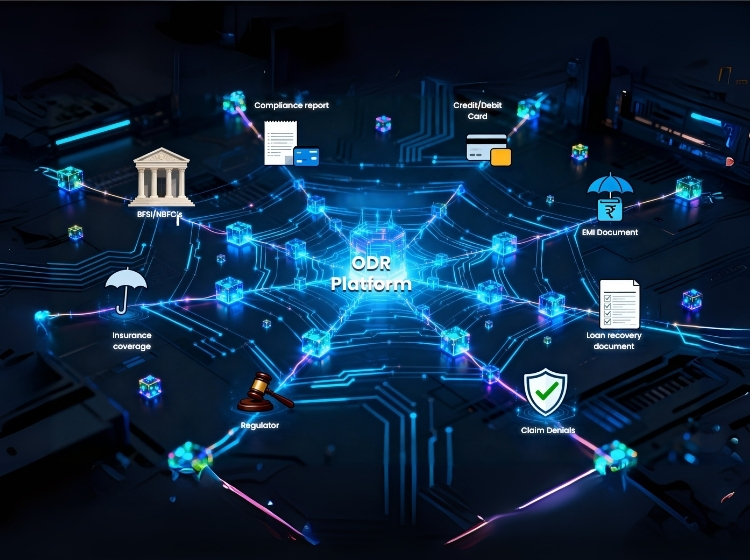
Jupitice Online Dispute Resolution (ODR) Platform
Resolve disputes in 30 days, not 9 years.
- End-to-end online arbitration, mediation, and negotiation
- AI-driven appointment of verified arbitrators and mediators from a global panel
- Legally binding, court-enforceable awards under the Indian Arbitration & Conciliation Act
- Blockchain-verified documentation and tamper-proof proceedings record
- Multi-party, multi-jurisdiction support for complex B2B disputes
- Trusted by 200+ private organisations and piloted with the Punjab Consumer Commission
Saya — The AI Intelligence Layer Across All Jupitice Products
At the core of Jupitice’s platform is Saya- an AI co-pilot that doesn’t just alert, but understands. Saya helps judges draft orders, assists legal teams with compliance queries in plain language, flags contract risks proactively, identifies patterns across dispute portfolios, and provides real-time contextual guidance to every user of the platform. It is not a chatbot. It is the intelligence layer that turns Jupitice from a management tool into a decision-support system.
The Business Case: Why 2026 Is the Year to Act
This is not a future trend. It is happening right now, across India’s enterprise legal landscape.
- India’s AI-powered legal tech market is projected to grow from USD 29.5 million in 2025 to over USD 106.3 million by 2030 – a 3.6x expansion in five years. Enterprises that adopt now will have a structural cost and capability advantage over those that wait.
- 50% of initial CLM implementations still fail, according to Gartner, because enterprises buy tools without adopting a platform-level approach. Jupitice’s Meta Product Platform is designed to prevent this with no-code configurability that legal and operations teams (not just IT) can own.
- Corporate AI adoption in legal more than doubled in one year — from 23% in 2024 to 54% in 2025, per an ACC/Everlaw survey. The laggards in this shift are not being left behind slowly. They are being left behind quickly.
- The e-Courts Phase III project (₹7,210 crore) is digitising India’s judicial infrastructure. Enterprises whose legal operations are not digitised will find the gap between their internal processes and the courts they interact with growing wider every year.
The question is no longer whether to adopt legal intelligence. The question is how long you can afford not to.
Where to Start
Legal transformation does not require a 24-month IT project or a ₹10 crore deployment. Jupitice’s platform is designed for rapid, no-code deployment — meaning your legal and compliance teams can configure workflows without waiting for IT.
Most enterprises begin with one of two entry points:
- Start with the pain that costs you most — whether that’s untracked litigation exposure, missed compliance deadlines, or a contract renewal that just cost ₹3 crore.
- Start with the risk that scares you most — whether that’s a DPDP audit, an NPA recovery backlog, or a vendor dispute escalating toward costly arbitration.
Either path leads to the same outcome: a legal function that no longer reacts to events, but anticipates them.
Sources & References
- National Judicial Data Grid (NJDG) — Pending Cases Data, March 2026. njdg.ecourts.gov.in
- India Data Map — Court Case Delays in India: 2025 Projections. indiadatamap.com
- World Commerce & Contracting — Contract Management Research, 2024–25. worldcc.com
- Thomson Reuters — Legal Department Operations (LDO) Index Report 2024. thomsonreuters.com
- NDTV / IBM Cost of Data Breach Report India — Average breach cost ₹22 Crore, 2026. ndtv.com
- Gartner — Predicts 40% of Enterprise Apps Will Feature Task-Specific AI Agents by 2026, August 2025. gartner.com
- RBI / PIB — Public Sector Banks NPA Ratio, March 2025. pib.gov.in
- Ken Research — India AI-Powered LegalTech & Compliance Market Report, 2025. kenresearch.com
- ACC / Everlaw — State of Legal AI Adoption Survey, 2025. acc.com