Shagun Preet
 10 Jun 2026
How a private sector bank lost six months of recovery momentum and what they built to make sure it never happened again. The claim was filed, the window was open, and nobody knew.
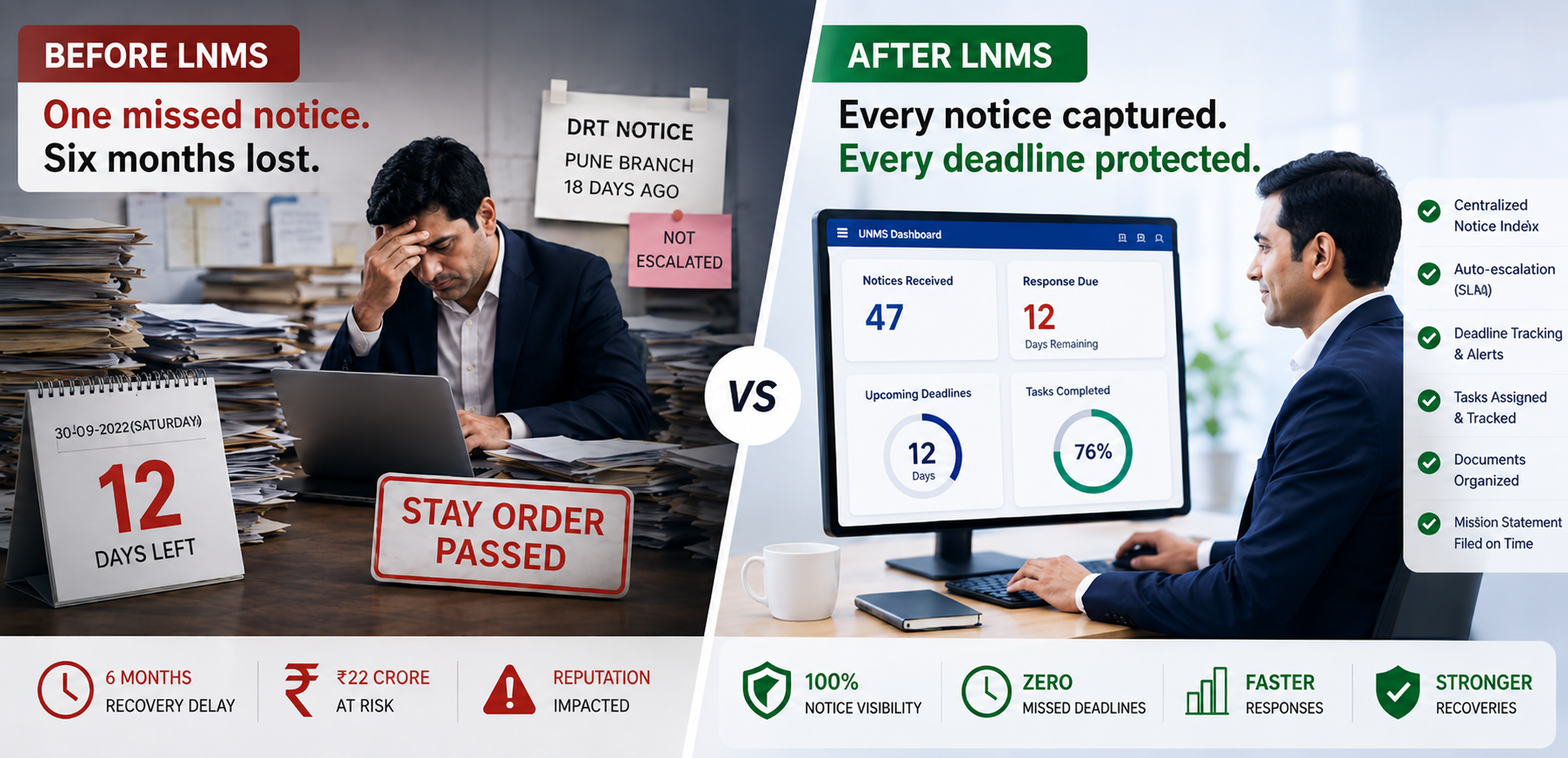
Rahul was DGM, Legal, at a privately-owned bank. He had to handle cases in 47 branches. An application under the Debt Recovery Tribunal, filed by a ₹22-crore NPA borrower, was sent to the Pune branch 18 days ago. A junior operations officer had signed the acknowledgement and thought that the case would be handled by someone else. But the case was not handled by anyone.
The legal proceedings were proper, and the case was good for recovery. The only problem was that the bank did not respond within 30 days of receipt of the notice because no one at headquarters was made aware of it.
Why India’s Bank Legal Teams Are Losing Ground And How to Take It Back
Every year, banks in India issue thousands of legal notices. Notices to recall NPA. Cheque bouncing notices under section 138. Legal arguments in the Debt Recovery Tribunal. Every year, irrespective of the sheer number of such processes and despite the high stakes involved, much of this work takes place using Excel sheets and emails shared among people.
It doesn’t take a genius to realise what follows: delays in sending legal letters; repeated issuance of notices; loss of legal documents; and compliance practices that collapse under any scrutiny from the RBI or the DRT.
This is precisely why Legal Notice Management System in India has become a critical requirement for modern banking operations. As regulatory scrutiny increases, banks are increasingly turning toward AI in Legal Tech solutions developed by specialised Legal Tech Company platforms that understand Indian compliance realities.
The Hidden Cost of Notice Mismanagement
Notices in banks do not constitute administrative documents. They are evidence of some nature. The service of a notice under Section 13(2) of the Sarfesi Act sets off a statutory process. The case under Section 13(4) is based on it. It will determine how successful an action will be before the DRT/DRAT, depending on whether the initial notice was properly delivered and registered within the set period.
If notice management is scattered among different branches, mailboxes, and officials, it could lead to a weaker position for the bank. This is because one missing delivery proof can make all the difference in a courtroom, favouring the borrower.
What a Modern Notice Management System Actually Does
The Legal Management Notice System was built specifically for the compliance architecture of Indian banking. It addresses every point in the notice lifecycle, from the moment a notice enters the system to the day a case is closed with the rigour that statutory and regulatory obligations demand.
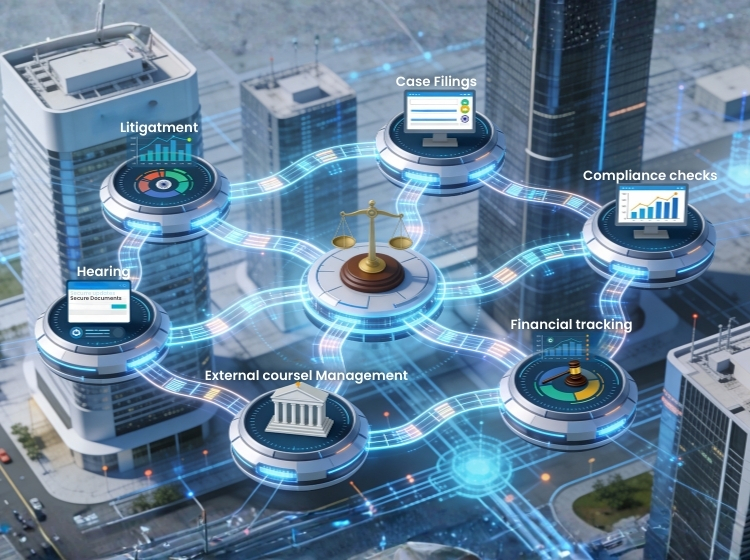
Modern AI in Legal Tech platforms are no longer an optional efficiency tool. They are operational safeguards. A next-generation Legal Tech Company now builds systems that combine compliance automation, workflow intelligence, document control, and litigation visibility into one unified ecosystem.
Intake That Leaves No Notice Behind
Every communication is automatically assigned a Unique ID, with duplicate entries flagged before processing. High-volume operations are streamlined through bulk uploads and automated workflows across multiple branches. Guided forms with pre-filled customer and account data enable faster creation and dispatch through Email, SMS, and WhatsApp with bulk eSign integration. The strength of a modern Legal Notice Management System in India lies in eliminating human dependency at the intake stage itself. Using AI in Legal Tech, the system ensures that notices are classified, routed, and escalated automatically without operational ambiguity.
Tracking That Closes the Loop
The notice will be considered complete once it has been served, replied to, and officially closed. The LNMS follows each notice through its lifecycle, providing real-time updates on its progress and compliance with statutory SLAs. Associated notices for the same borrower or account will be automatically grouped together into their respective case chronologies, borrower responses, possession notices, and petitions, all of which can be viewed together in one place. When statutory time periods are imminent, the system’s artificial intelligence agent, Saya AI, will automatically escalate the process to the relevant officer.
Workflows That Enforce the Right Hierarchy
The most dangerous gap in a bank’s legal process is an approval that was assumed rather than confirmed. Legal Notice Management System eliminates this with configurable, no-code workflows that route every notice through the correct hierarchy in sequence, junior counsel drafts, senior counsel reviews, compliance approves, and an empanelled advocate is assigned, without manual coordination at each step.
Routing logic accounts for notice type, geography, loan value, and organisational hierarchy. The right person always gets the right notice at the right time. This is where AI in Legal Tech delivers measurable operational value by reducing delays, approval bottlenecks, and compliance failures across large banking networks.
Documents That Are Always Court-Ready
Every notice, response draft, proof of dispatch, court order, and counsel opinion is stored in an encrypted, version-controlled vault. AI-powered semantic search surfaces any document by borrower name, account number, notice type, or clause text in seconds.
There are no version conflicts. There are no lost attachments. There is no scrambling before a hearing. A sophisticated Legal Notice Management System ensures that every legal document becomes instantly retrievable and permanently auditable. This level of digital evidence control represents the practical evolution of AI in Legal Tech from experimentation into mission-critical infrastructure.
Compliance That Survives Scrutiny
For RBI inspections and DRT proceedings alike, Legal Notice Management System provides a complete, timestamped, tamper-proof record of every notice action. Blockchain timestamping offers optional immutable proof of notice authenticity. Aadhaar OTP and eSign provide a legally binding digital authorisation for every upload and approval.
Every access, edit, and approval is logged with a timestamp and user identity, permanently. Audit packs for any date range, zone, or notice type can be exported in minutes.
Collaboration Without Chaos
High-value NPA matters involve in-house counsel, recovery teams, external advocates, and senior management across cities, and often against tight deadlines. Legal Notice Management System anchors all collaboration directly inside the notice record: discussion rooms, real-time co-drafting, video calls with automatic transcription, and action item extraction.
No email threads. No version conflicts. No dropped context.
Visibility That Drives Decisions
Legal risk concentrates in specific branches, loan products, and geographies. Legal Notice Management System makes this visible through real-time dashboards and scheduled MIS reports covering notice volumes, SLA breach rates, NPA exposure by region, and counsel performance.
When leadership can see where the legal workload is concentrated and where SLAs are being breached, and why, they can act on it; resource reallocation, process correction, and performance management all become data-driven rather than reactive. This analytical visibility is one of the biggest advantages that a modern Legal Tech Company brings into enterprise banking operations through AI in Legal Tech systems.
Mobility That Matches the Job
Statutory deadlines do not pause for travel. Legal Notice Management System’s mobile interface brings the complete legal workflow, approvals, comments, evidence capture, and escalation alerts to any smartphone. Senior officers can review, approve, and act from anywhere, without a laptop and without delay.
Scale Without Customisation
Legal Notice Management System handles multilingual notices across major Indian languages, auto-translating, classifying, and routing notices. It scales from a single legal department to a multi-entity banking group without custom development. As the banking sector grows increasingly digital, scalable AI in Legal Tech infrastructure is becoming foundational to legal and recovery operations.
The Standard Has Changed
Indian banks operate in a legal environment where procedural compliance is as consequential as substantive legal argument. A bank with the right legal position but a broken notice trail can still lose. A bank with strong documentation, airtight dispatch records, and zero missed escalations walks into every DRT proceeding from a position of strength.
Legal Notice Management System exists to ensure that every notice your bank issues or receives is logged, tracked, dispatched, and documented to the standard that courts, regulators, and auditors demand. The next notice your legal team receives is already in motion. The only question is whether your system is ready for it.
Legal Notice Management System. Built for compliance. Powered by AI in Legal Tech. Designed by a next-generation Legal Tech Company – Jupitice Justice Technologies.