Prerna Jagga
 16 Nov 2026

Data privacy is no longer just an IT responsibility. It is becoming a business-wide compliance obligation.
Every time an organisation collects customer details, processes employee records, manages financial information, or shares personal data with vendors, it assumes responsibility for how that information is handled.
The Digital Personal Data Protection (DPDP) Act, 2023, along with the DPDP Rules, 2025, sets out the legal framework for protecting digital personal data and holding organisations accountable.
For Indian businesses, understanding the DPDP Act is only the beginning. The real challenge is translating its requirements into everyday business operations.
What Is the DPDP Act 2023?
The Digital Personal Data Protection Act, 2023, is India’s law that regulates the processing of digital personal data in the country.
It sets out individuals’ rights and the duties of organisations that handle individuals’ data.
The Act introduces three important terms:
- Data Principal: The individual to whom personal data relates.
- Data Fiduciary: An organisation or person determining the purpose and means of processing personal data.
- Data Processor: An entity processing personal data on behalf of a Data Fiduciary.
The basic idea is clear – organisations must process data about individuals in ways that are legal and protect their rights.
Who Must Comply with the DPDP Act?
One common misconception is that DPDP compliance applies only to technology companies.
In reality, the Act is sector-agnostic and can apply to organisations across industries, including:
- Banking and BFSI: Customer onboarding, KYC, lending, and financial records.
- Healthcare: Patient information, diagnostics, and medical records.
- Telecom: Subscriber information and digital service records.
- Retail and E-commerce: Customer profiles, purchase histories, and marketing data.
- Manufacturing: Employee information, vendor records, and customer databases.
- HR and IT Services: Employee records, recruitment information, and outsourced data processing.
The Act covers digital personal data collected digitally or collected offline and subsequently digitised, subject to statutory exclusions.
It can also apply to organisations outside India when processing personal data in connection with offering goods or services to Data Principals within India.
The key question is not which industry you operate in, but whether your business processes digital personal data covered by the Act.
Key DPDP Act Compliance Requirements for Businesses
1. Lawful Processing and Consent Management
Businesses must establish a valid legal basis for processing personal data.
Under the Act, processing may be based on consent or certain legitimate uses recognised under Section 7.
Where consent is required, it must be free, specific, informed, unconditional, and unambiguous, involving clear affirmative action.
Organisations must also enable individuals to withdraw consent as easily as they provided it.
2. Clear Privacy Notices
Businesses must provide notices explaining what personal data is being processed and for which purposes.
Notices must also explain how individuals can exercise their rights and raise grievances.
Managing notice versions, languages, and consent records is important for demonstrating compliance.
3. Data Security and Breach Management
Section 8(5) requires Data Fiduciaries to implement reasonable security safeguards to prevent personal data breaches.
Organisations must also notify the Data Protection Board of India and affected individuals when a personal data breach occurs, in accordance with applicable requirements.
Under the DPDP Act Rules, 2025, detailed information must be provided to the Board within the prescribed 72-hour period, unless the Board extends the deadline.
4. Data Principal Rights
DPDP Act provides individuals with rights relating to their personal data, including:
- Access to information about personal data processing.
- Correction, completion, and updating of personal data.
- Erasure of personal data, subject to applicable legal requirements.
- Grievance redressal.
- Nomination of another individual to exercise rights in specified circumstances.
Businesses need accessible mechanisms to receive, verify, track, and respond to these requests.
5. Data Retention and Deletion
Personal data should not be retained indefinitely.
Businesses must erase personal data when the relevant purpose is no longer served or consent is withdrawn, unless retention is necessary under applicable law.
This requires defined retention policies, deletion workflows, and appropriate records of decisions.
6. Third-Party and Vendor Accountability
Businesses frequently rely on cloud providers, payment gateways, outsourcing partners, and other vendors.
Under Section 8(1), Data Fiduciaries remain responsible for compliance with the DPDP Act and its rules, including personal data processing carried out on their behalf by Data Processors.
Under Section 8(2), Data Fiduciaries may engage Data Processors only under valid contracts.
Maintaining processor records, contractual safeguards, and oversight mechanisms is therefore essential.
DPDP Act Implementation Timeline: Important Dates
The DPDP framework follows a phased implementation schedule under the notification dated 13 November 2025.
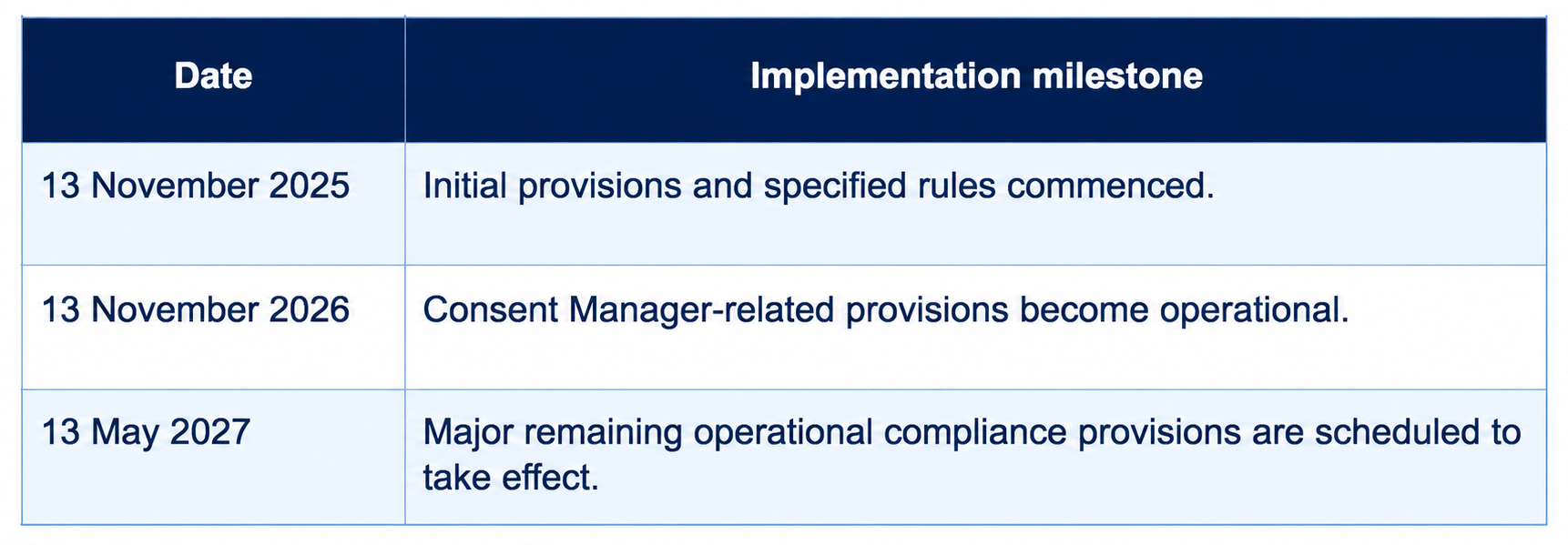
Enterprises and businesses should use this period to evaluate their data processing activities and ensure that proper governance structures and compliance controls are in place.
What Are the Penalties Under the DPDP Act?
Non-compliance can expose organisations to significant financial penalties.
The Act provides for penalties of up to:
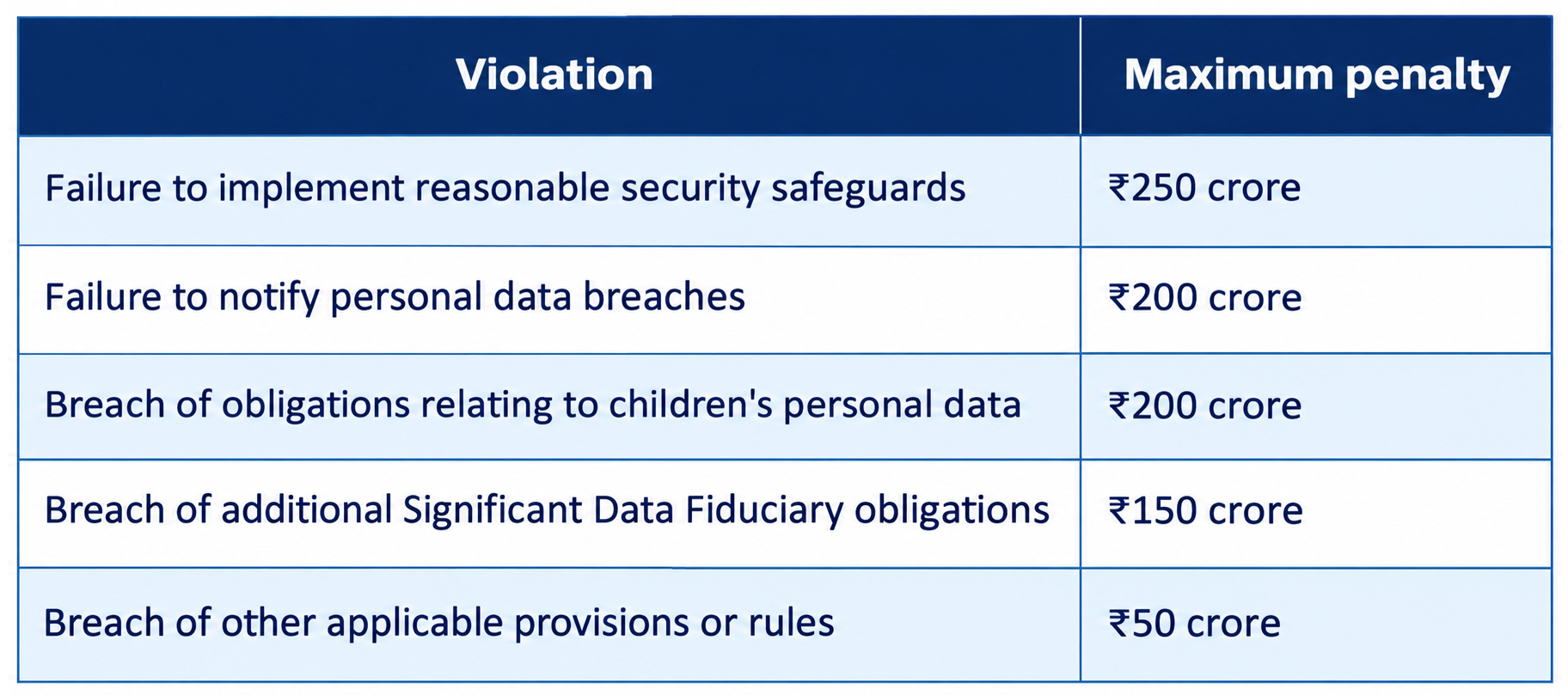
They are statutory maxima for designated infringements, not automatic fines.
Penalties are set by the Data Protection Board based on the circumstances and the relevant provisions of the Act.
How Can Indian Businesses Prepare for DPDP Compliance?
DPDP readiness requires coordinated action across legal, compliance, IT, security, HR, and business teams.
Enterprises should begin by:
- Mapping personal data: Identify what information you collect, where you store it, and how it moves across systems.
- Reviewing processing purposes: Establish the applicable lawful basis for each activity.
- Strengthening consent governance: Maintain notices, consent records, and withdrawal mechanisms.
- Assessing third-party processors: Review vendor contracts, processing activities, and security obligations.
- Establishing response workflows: Prepare for data rights requests, breaches, retention decisions, and regulatory inquiries.
- Maintaining compliance evidence: Document responsibilities, decisions, approvals, and actions.
The objective is not simply to create policies but to ensure that compliance requirements are consistently followed and demonstrable.
Simplifying DPDP Compliance with Shivault – DPDP OS by Jupitice
Managing DPDP obligations across departments, systems, and third-party processors can become complex, particularly for large enterprises.
Shivault – DPDP OS by Jupitice helps organisations bring their privacy compliance activities into a connected, accountable operating environment.
Built around 55 connected modules and seven capability layers, the platform addresses key areas including:
- Data discovery, inventory, and mapping.
- Legal and compliance intelligence.
- Consent management and Data Principal rights.
- Processor and third-party governance.
- Risk, retention, and breach management.
- Audit evidence and regulatory readiness.
- AI-assisted compliance intelligence and training.
With centralised workflows, ownership tracking, compliance dashboards, and evidence management, Shivault helps enterprises move from fragmented compliance activities towards a more structured approach.
Conclusion
The DPDP Act, 2023 is a significant departure from previous approaches by Indian organisations to protecting personal data.
Compliance calls for far more than just a privacy policy or one-time assessment. Visibility into data-processing operations, accountability, controls, and evidence are what compliance really entails.
For organisations gearing up for future compliance obligations, now is the time to prepare.
Is your enterprise ready to demonstrate DPDP compliance?
Explore Shivault – DPDP OS by Jupitice and discover how your organisation can strengthen its data privacy compliance framework.
Book a demo with Jupitice today.
Sources and References:
- Digital Personal Data Protection Act, 2023 — Ministry of Electronics and Information Technology, Government of India.
- Digital Personal Data Protection Rules, 2025 — Gazette of India.
- DPDP Act Commencement Notification, G.S.R. 843(E) — Gazette of India.
- DPDP Rules, 2025 — Government Explainer — Press Information Bureau, Government of India.