Editorial Team
 04 Feb 2026

Artificial intelligence is no longer just helping people “work faster”. In many sectors, it has started shaping how entire processes function. Today, even the law, slowly and carefully, is moving in the same direction. Litigation is one of the most significant landscapes that is silently getting metamorphosed, but it does not behave like other domains.
A lawsuit is not just mere data. It is tied to jurisdiction, procedure, limitation periods, and institutional responsibility. But far more than that, it is deeply ingrained in people’s lives. Here, every case, every file lives inside a legal framework that is local, rule-bound, and unforgiving of error, which means that the Intelligence that is applied here cannot be generic or vague. It has to respect context and needs to be specialised.
This is exactly where much of the current conversation around AI in law feels incomplete. Yes, adoption is rising. Industry reports show that more than 70% of law firms are exploring or piloting AI tools in some form. But when we take a closer look, most of that usage is only surface- level.
Litigation, in reality, is far too complex to be simplified by an API integration. It unfolds over months or years, across forums, with repeated patterns, missed deadlines, duplicated cases, and growing risk. Ask a Legal Head from the BFSI sector, and you’ll know just how many stakeholders, how much research, and how much manpower it takes to get a few cases to finally settle out of a zillion.
Managing that level of complexity requires systems that can see the whole picture. That is where Litigation Management Systems come into the picture and where Jupitice’s Saya (AI) starts to mean something entirely apart.
How AI Is Commonly Used Today in Litigation Management?
For most legal teams, AI first shows up as an assistant. It helps find cases faster. It summarises long documents. It drafts a first version of a note or response. These tools save time, and of course, that matters.
But the data shows a clear limitation. While 30–40% of lawyers report using AI tools, only a small fraction of firms have integrated AI into their core workflows. That is a big disparity. Even among large firms, full implementation is the exception. Smaller and mid-sized firms lack resources and are way more cautious in comparison. And there is a reason for this hesitation.
Tools often operate in isolation. They do not understand how cases relate to each other. They do not track how litigation evolves over time. They do not help manage scale. As a result, AI remains something lawyers “use,” rather than something the system itself relies on.
PS: It is needless to say that AI needs human intervention and manoeuvring, but that shouldn’t stop leaders from leveraging the full extent of AI in their legal processes.
Why Current Litigation Management Is a Different Problem
Litigation is repetitive, but never identical. Large organisations may handle thousands of cases that look similar on the surface but differ in form, stage, or legal posture. Deadlines matter. Limitation periods matter. A missed step can have real consequences involving billions of dollars across the globe.
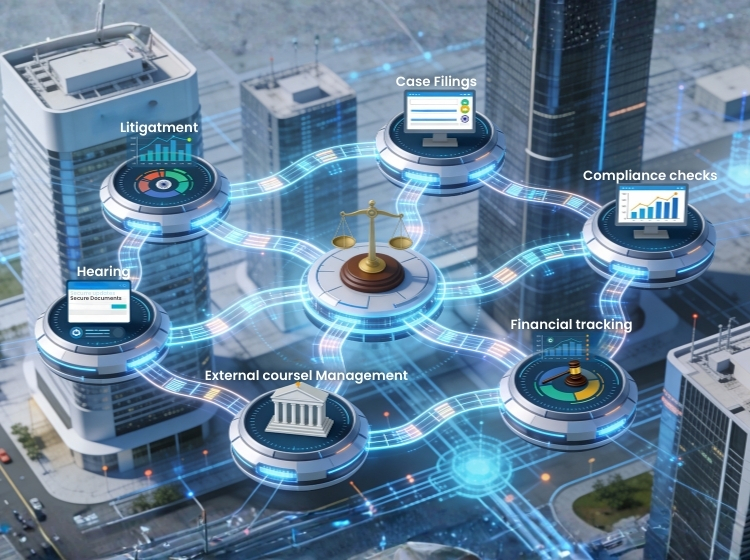
A litigation management system is meant to deal with this reality. Ideally, it should track cases end-to-end, coordinate lawyers, documents, hearings, and payments all on a single platform. It creates visibility where there is otherwise fragmentation.
When AI enters this environment, its role changes. It is no longer just answering questions. It starts helping the system recognise patterns, flag risks, and reduce noise. This is where AI becomes less visible, but more powerful.
What Jupitice’s Saya (AI) Can Actually Do Inside a Litigation Management System?
Once Saya (AI) is a part of the litigation workflows, its value shifts from content generation to decision support.
- Saya (AI) can help group similar cases so they are handled together instead of repeatedly.
- Saya (AI) can flag matters that are already settled or decided but continue to consume attention.
- Saya (AI) can identify cases approaching limitation periods before they turn into liabilities.
- Saya (AI) can connect related matters that would otherwise remain siloed.
- Saya (AI) can also assist with allocation, routing cases based on workload, expertise, or geography, something that is extremely difficult to manage manually at scale.
Search becomes contextual rather than keyword-based. Documents can be queried in plain language. Transcription and translation reduce friction across regions and courts.
None of this replaces or even is meant to replace legal judgment. What it does is reduce blind spots and remove the risk of manual errors so that legal teams can work more efficiently.
From Tools to Integrated Litigation Intelligence
A different approach to Litigation Management is emerging, one where litigation is treated like an enterprise function, supported by an integrated system rather than scattered tools. This is where platforms like Jupitice’s Litigation Management System fit into the broader picture.
Jupitice approaches litigation as infrastructure. Its LMS (Litigation Management System) brings together case data repository, court integrations, hearings and internal communications, case management, billing, data reporting & analytics, and much more into a single system. AI is not added as a chatbot layer, but woven into how cases are allocated, grouped, searched, and reviewed.
Features such as automated allocation, identification of similar or frivolous cases, limitation period detection, document Q&A, and AI-powered search reflect this shift. The focus is not on predicting outcomes or replacing lawyers, but on making large-scale litigation manageable, transparent, and controlled.
In addition, when everything is performed on the platform, it creates an uneditable log, which becomes an auditable trail, keeping everything in a digital record.
Human Judgment Still Comes First
As AI becomes more embedded, the question of control becomes crucial. As mentioned earlier, litigation cannot (and should not) be automated end-to-end, it has to be overseen by lawyers and institutions with responsibility and accountability.
Industry data makes this clear. Only about 11% of firms currently audit AI-generated outputs regularly, and many are still developing basic governance frameworks. Trust in AI grows when systems are explainable, auditable, and role-bound.
This is where design matters. AI must assist without deciding. It must surface insights without obscuring accountability. In litigation, that balance is not optional.
Where Does This Leave the Industry?
AI in litigation is no longer a future concept. It is already here, but unevenly applied and poorly executed. Most adoption today remains narrow, focused on efficiency at the individual level instead of being utilised at an institutional level. The next phase is about systems, about embedding intelligence into the way litigation is managed at scale, with precision.
When Jupitice’s Saya (AI) is integrated thoughtfully, it does not just save time. It reduces risk, reveals patterns, and restores visibility to processes that have long been opaque.
Jupitice Litigation Management System is gradually bringing that shift, filling the cracks, one system at a time. The real question is no longer whether AI will be used in litigation. It is how carefully, how contextually, and how responsibly it will be embedded into the systems that carry legal accountability.