Editorial Team
 02 Jan 2026

“Because compliance is not about intention. It is about design.”
India’s Digital Personal Data Protection (DPDP) Act marks a defining shift in how organisations must think about data. For the first time, the law moves data protection away from isolated IT controls and places responsibility squarely on how entire systems are designed, operated, and governed.
Yet, as 2026 approaches, a hard truth is emerging!
Many organisations believe they are DPDP-ready simply because they use digital tools. In reality, their data is still scattered across emails, shared drives, video conferencing apps, spreadsheets, legacy software, and paper files. It means that control is being assumed, but rarely demonstrated.
DPDP is designed to test exactly that gap!
This blog explains what DPDP really requires, why fragmented digitisation is becoming a serious liability, and why end-to-end platforms, not point tools, are quickly becoming the safest path to sustainable compliance.
What Exactly Is DPDP and Why Does It Matter?
The Digital Personal Data Protection Act, 2023, establishes India’s unified legal framework for how personal data is collected, processed, stored, accessed, shared, and deleted.
In January 2025, the Government of India published the draft Digital Personal Data Protection Rules, 2025, for public consultation, signalling the operational phase of the Act. Together, the Act and the proposed Rules clarify how organisations are expected to implement data protection obligations in practice, across sectors.
At its core, DPDP introduces a simple but powerful principle:
If you collect personal data, you must be able to demonstrate control over it throughout its lifecycle.
This includes:
- Knowing what personal data you hold
- Knowing why you hold it
- Knowing who can access it
- Knowing how long it is retained
- Being able to audit, restrict, correct, or delete it when required
The law applies across sectors, including banks, financial institutions, government departments, regulators, quasi-judicial bodies, enterprises, and platforms that handle citizen or customer data, all of which are within scope.
Additionally, it is worth noting that, although DPDP is technology-agnostic, it remains system-specific. It does not prescribe specific software; instead, it assesses whether an organisation’s systems make accountability possible in practice.
That is where many existing digital environments fall short!
The Illusion of Being “Digital”
Most organisations today appear highly digital on the surface. The documents are emailed, meetings are held via video calls, files are uploaded to shared drives, tracking is done in spreadsheets or task tools, and even notices are sent through messaging platforms.
Individually, all these tools work well. However, collectively, they create what many CIOs quietly describe as tool sprawl – a situation where multiple disconnected applications are used to run a single process, causing data to be scattered, duplicated, and governed differently across systems.
So, the exact problem is not digitisation; it’s fragmentation!
When personal data flows through disconnected tools:
- No single system holds the complete record.
- Access controls differ across platforms.
- Audit logs are scattered and inconsistent.
- Data copies multiply without visibility.
From a DPDP perspective, this creates asymmetric data environments, where no one can confidently answer a basic regulatory question:
Who accessed this data, when, under what authority, and for what purpose?
Why Point Tools Fail the DPDP Test
Point tools are designed to handle individual tasks in isolation. For instance, emails are used for communication, video tools host meetings, file-sharing systems store documents, and ticketing tools track actions.
However, DPDP does not regulate a specific task; it regulates data journeys!
When organisations stitch together (like a patchwork) multiple tools to run a single process, several structural risks emerge:
- Data sprawl
The same personal data exists in multiple formats, locations, and versions, often outside formal governance. - Inconsistent access control
Each tool has its own roles, permissions, and sharing logic, making it difficult to enforce uniform access policies. - Fragmented audit trails
Logs exist, but not in one place, not in one format, and not linked to a complete lifecycle. - Higher breach exposure
Every additional tool expands the attack surface and increases configuration complexity.
These are not just operational inconveniences. Under DPDP, they translate directly into governance risk.
What DPDP Is Really Asking Organisations to Prove
One of the most misunderstood aspects of DPDP is that it is not a checklist law. It does not ask:
“Did you install encryption?” “Do you have a policy document?” Instead, it asks: “Can you demonstrate control, consistently and end-to-end?”
This includes the ability to:
- Restrict access based on role and purpose
- Track every meaningful action on personal data
- Enforce retention and deletion rules
- Respond to regulatory or data principal requests with confidence
Achieving this level of assurance is extremely difficult when processes span emails, paper files, consumer tools, and disconnected enterprise applications.
This is why DPDP is quietly pushing organisations towards a different architectural model.
From Fragmented Tools to End-to-End Systems
An end-to-end platform is fundamentally different from a bundle of tools. Instead of digitising individual steps, it digitises the entire lifecycle of a process on a single governed system.
In such a model:
- Each case, customer, or transaction has one authoritative digital record
- Documents, communications, hearings, decisions, and actions attach to that record
- Identity and access are defined once and enforced everywhere
- Audit logs are generated automatically across the lifecycle
This creates symmetric data environments, where information remains structured, traceable, and governable from start to finish.
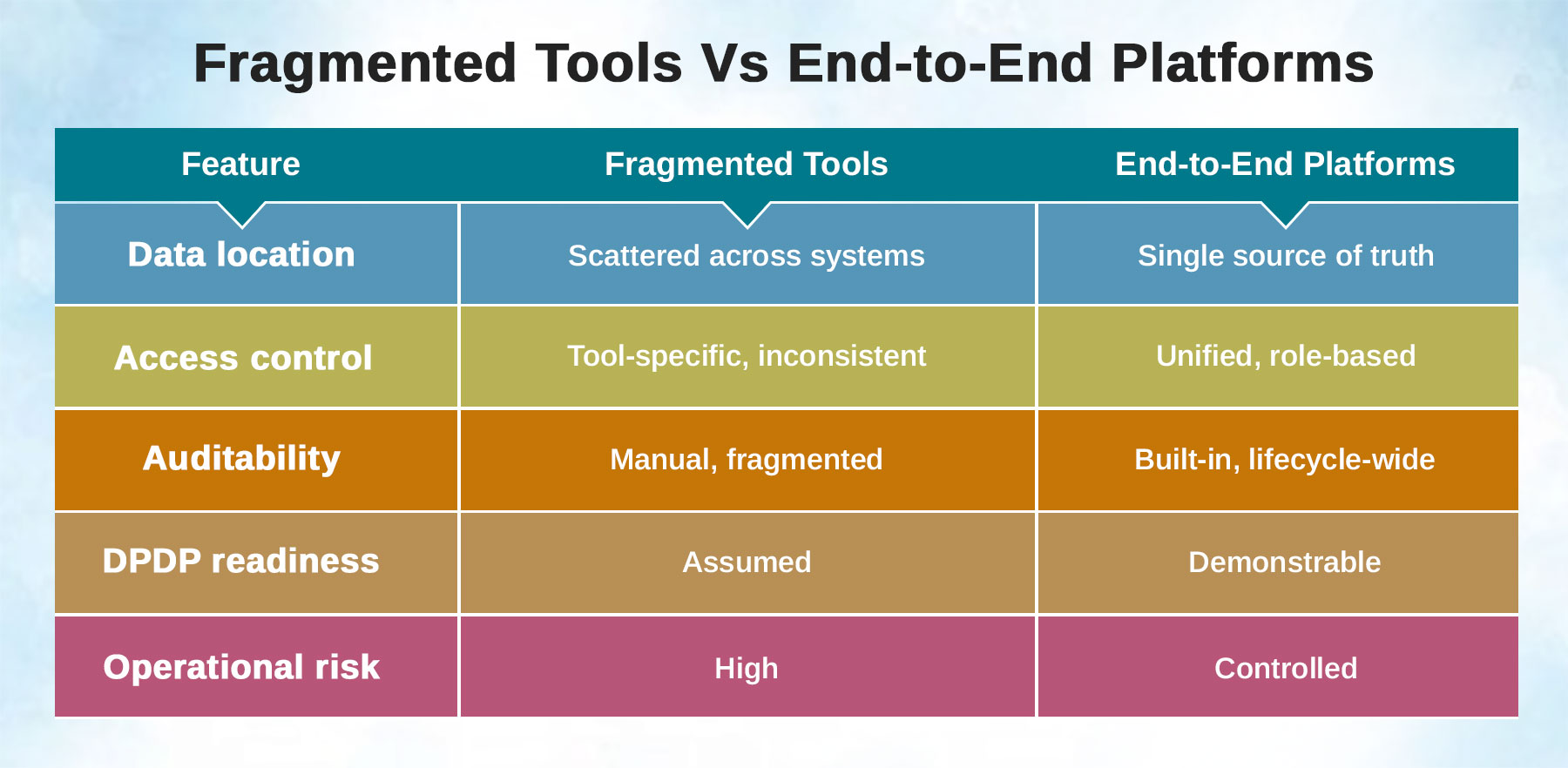
Why This Matters More for BFSI and Government Institutions
For BFSI organisations, data sensitivity is inherent. From financial records and identity documents to customer communications and decisions, the data involved is deeply personal and tightly regulated.
For government bodies and regulators, the stakes are even higher. Citizen data is not just sensitive, it is foundational to public trust.
In both cases:
- Manual workarounds increase risk
- Paper records undermine auditability
- External tools weaken confidentiality
- Fragmentation makes accountability fragile
DPDP raises expectations precisely in these environments, where scale, sensitivity, and scrutiny intersect.
What an End-to-End Platform Looks Like in Practice
Jupitice approaches DPDP not as a compliance overlay, but as a system design problem. Built on its purpose-built, AI-powered, Meta Product Platform, Jupitice delivers end-to-end digital systems for justice, governance, regulation, dispute resolution, and enterprise processes, where:
- Entire workflows operate on a common data layer
- Identity and access controls are embedded across modules
- Communications, hearings, documents, and decisions remain within the system
- Every action is logged, traceable, and auditable by design
Instead of adding more tools, organisations move towards one governed operating environment that naturally supports DPDP obligations.
This is particularly relevant for institutions handling complex, multi-stage processes involving sensitive personal data.
“DPDP compliance is not achieved through more policies. It is achieved through better systems.”
The Strategic Question Leaders Must Ask Now
DPDP is not about future penalties or timelines. It is about whether your organisation can confidently say:
- We know where our data lives
- We know who can access it
- We can prove what happened to it
If the answer depends on manual coordination across tools, inboxes, and spreadsheets, the risk is already embedded in the system. Overall, what is required is not surface-level change, but a fundamental shift in system architecture.
Take Away
As India’s data protection regime continues to mature, organisations will, increasingly, be assessed not by what they claim, but by what their data systems can consistently demonstrate.
In practice, many organisations grew digital by adding tools as needs evolved. For a time, this approach enabled speed and flexibility; however, under DPDP, such fragmented digitisation has now emerged as a structural weakness, limiting control, traceability, and accountability.
Against this backdrop, end-to-end platforms address the gap by offering what point tools cannot: a unified view of data, consistent governance across workflows, and system-level assurance.
As a result, in a regulatory environment where accountability must be clearly demonstrated, clarity, control, and confidence are no longer optional. They form the foundation of compliant data systems!
So, Are You Ready to Re-evaluate Your Data Systems?
If your organisation is reassessing how its data systems align with DPDP expectations, now is the right time to move from tools to platforms.
Explore how Jupitice helps organisations build governed, end-to-end digital systems at