admin
admin
 04 Nov 2025

For years, registering a property anywhere in India has been a frustrating experience for citizens. Long queues at sub-registrar offices, repetitive visits, mountains of paperwork, and opaque processes drained time and patience. Buyers were caught in a web of delays and uncertainties. They had no clear way to track their applications or get timely help. Some even suffered serious financial losses due to prolonged registration delays or fraudulent practices by corrupt officials.
To understand the criticality of the existing system, let us consider the story of Vivek Khushlani, a property owner from Hisar, Haryana. His family’s land purchase (dating back several decades) became a cautionary tale of the inefficiencies in the old manual system.
Despite having legal documentation, registered sale deeds, and mutations over the years, procedural hurdles and delays in the physical registration process left his ownership rights vulnerable. The exact loophole in the system was the repeated visits to local offices, lost paperwork, and disconnected records, which culminated in the loss of legal recognition of the property.
Vivek’s struggle has even been documented in legal archives and case studies. No wonder thousands of families across Haryana faced similar roadblocks, followed by financial losses, emotional distress, and a deep sense of helplessness caused by an outdated, error-prone registration framework. His story powerfully illustrates why we urgently need a modern, streamlined, and transparent registration system.
The New Era of Digital Property Registration
Recognising these persistent problems of property registration, the Haryana government launched a novel revolutionary solution, Faceless Property Registration System, powered by Jupitice Justice Technology, on 1st November 2025. This platform ushers in a new era of completely online, transparent, and citizen-friendly property registration.
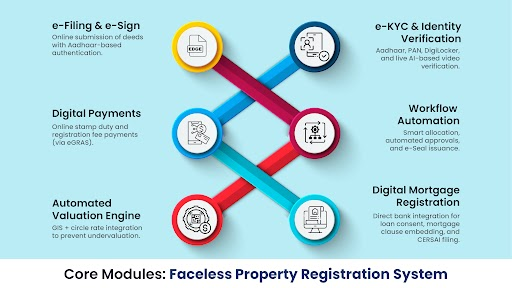
Now, the days of physically visiting offices, standing in long queues, and handling piles of paper are over. Citizens can now register their properties entirely online. From Aadhaar-based KYC and video identity verification to digital payments and real-time tracking, citizens can now do everything without leaving their homes.
How the New System Works for Citizens
Instant Aadhaar-based account creation and video KYC remove the need for physical document submission.
Online form submission and document upload make the process smooth and efficient, with a unique application ID to track progress.
Virtual joint registration rooms enable buyers, sellers, and banks to participate in registration via online video conferencing — saving time and travel costs.
Digital payment gateways ensure secure payment of stamp duty and registration fees with instant receipts.
AI-driven chatbots provide 24/7 guidance and real-time answers to citizens’ queries.
Instant downloading of digitally signed sale deeds and acknowledgements completes the process in record time.
Transforming Government Efficiency and Transparency
The platform is carefully designed to help the officials too as it can automate document scrutiny using rule-based validations, further reducing manual errors and curbing fraud.
Every task will now be monitored with alerts and reminders, ensuring deadlines are met and accountability is maintained. NOCs can be issued digitally, and all data is stored in a centralized, secure repository with full audit trails.
Integration with Haryana’s land records (HALRIS), Jamabandi databases, Aadhaar, and payment systems means data flows seamlessly, reducing redundancy and speeding up mutation and record updates.
“This transformation redefines what good governance looks like in the 21st century — a seamless, accountable, and empowering experience for every citizen.”
Empowering Trust: The Digital Revolution Transforming Property Registration
This shift marks a remarkable social change. Where buyers once faced months-long waits and risks of forged or lost documents, they now enjoy fast, transparent registration that protects their investments. The rampant fraud uncovered in previous years, where officials manipulated records unlawfully in Gurugram and elsewhere, is being replaced by traceable, tamper-proof digital records.
The system’s QR code-based feedback mechanism empowers citizens to rate services and report issues instantly, further strengthening trust.
The Chief Minister of Haryana, Nayab Singh Saini, hailed this as a landmark move that saves citizens’ time, money, and energy while setting a national standard in digital governance.
India’s Blueprint for Smart, Transparent Governance
Haryana’s Faceless Property Registration System, powered by Jupitice Justice Technologies, is an exemplary move for other states aiming to digitise and simplify public services.
It not only eliminates physical paperwork and reduces corruption risks but also fosters trust through transparency and access to real-time information (24/7). Basically, this move embodies the true spirit of Digital India, demonstrating how technological innovation can lead to seamless, citizen-centric governance.
In a nutshell, as this transformative initiative sets a new national benchmark, it highlights the potential for digital solutions, driven by visionary public-private partnerships, to reshape public service delivery across India.
“It’s time to reimagine governance the Jupitice way — where every system is transparent, every process is efficient, and every citizen’s experience is just.”
It’s Time to Take the Next Step
The success of Haryana’s Faceless Property Registration System proves that digital transformation in governance is not just possible — it’s powerful.
If your organisation or department is ready to digitise citizen services, streamline public operations, or build the next transparent governance system, Jupitice can help make it happen.
Connect with Us
To explore how our Justice Technology can empower your digital transformation journey.