Shagun Preet
 23 Apr 2026

For institutions, managing thousands of contracts with borrowers, vendors, and regulators, Contract Management remains one of the most under-digitised, over-exposed operational functions in the enterprise. The consequences are not administrative inconveniences. They are revenue leakage, audit failures, legal exposure, and delayed business execution, all entirely preventable.
The Scale of the Problem: Numbers That Should Concern Every Institution
Before examining solutions, let us be precise about the magnitude of the challenge. Industry research paints an unambiguous picture of how costly poor contract management truly is.
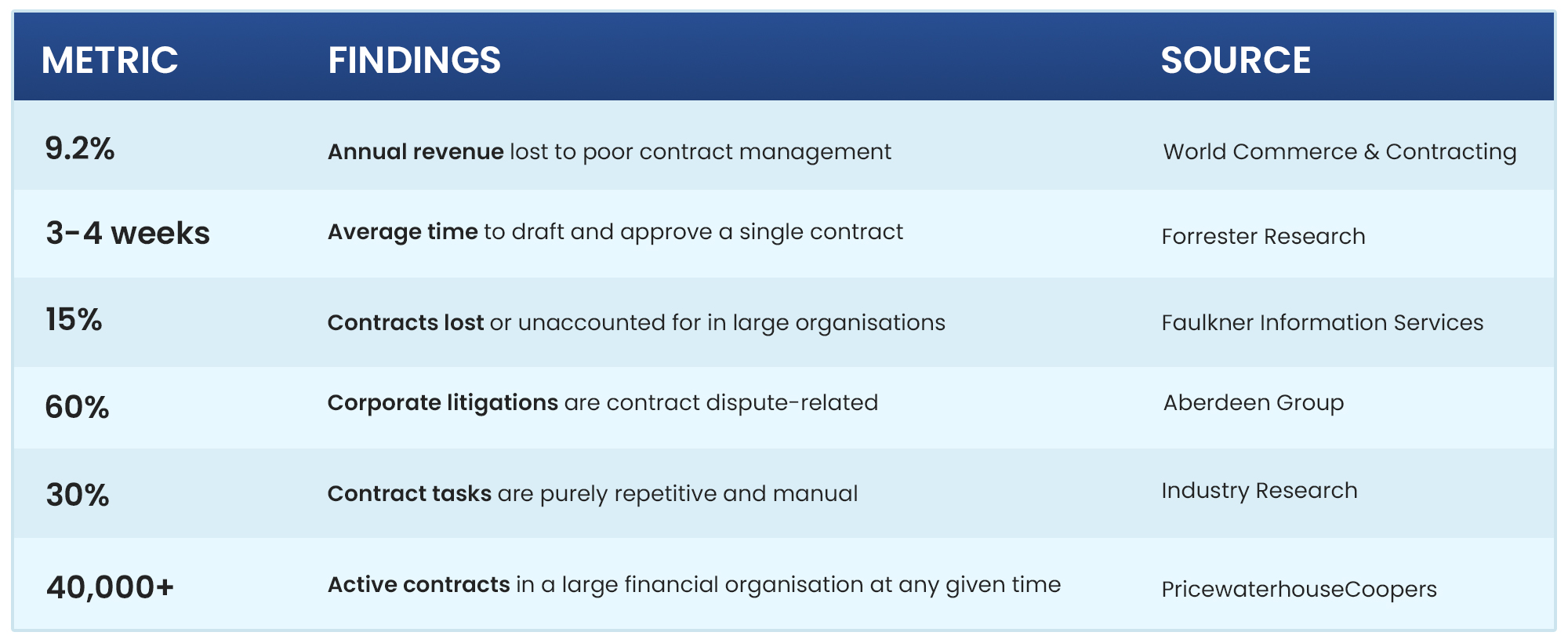
For a Non-Banking Financial Company disbursing thousands of loans per month, a bank managing multi-layered vendor relationships, or an insurer processing a high volume of policy-linked agreements, these numbers translate directly into board-level risk. The question is not whether your organisation has a contract management problem. The question is how large it already is.
The Real Pain Points
Institutions managing high contract volumes face compounding operational risks: documents are scattered across inboxes and shared drives, with no centralised visibility; approval cycles are slow enough to cost revenue; and the absence of automated obligation tracking leaves organisations perpetually exposed to regulatory scrutiny. Missed renewals, inconsistent clause language, and the inability to produce audit-ready records on demand compound the problem, while legal teams remain bottlenecked reviewing routine agreements that automation could handle, creating a system that is simultaneously inefficient, risky, and difficult to scale.
Poor contract management rarely announces itself, it accumulates quietly in missed renewals, delayed approvals, and compliance gaps until the cost is too large to ignore.
What Is Jupitice’s Contract Lifecycle Management and Why Does the Full Lifecycle Matter?
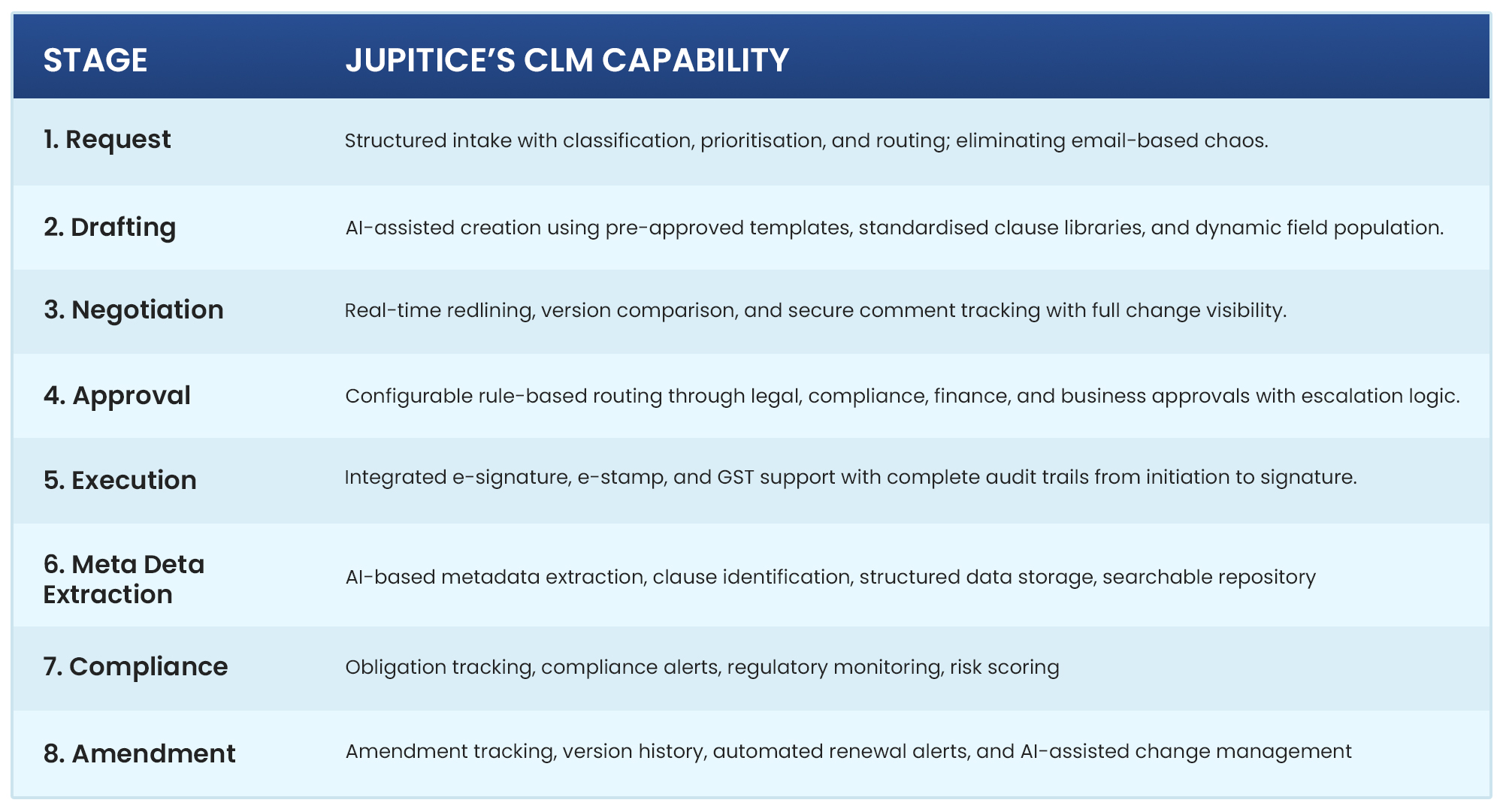
Jupitice’s Contract Lifecycle Management (CLM) is the systematic digitisation and automation of every stage in a contract’s existence from the moment a business need is identified to the moment the relationship governed by that contract ends.
Jupitice AI-powered CLM centralises the entire contract lifecycle, from smart, template-based drafting and collaborative negotiation to automated alerts, compliance tracking, and real-time dashboards, so institutions can manage high contract volumes with precision, eliminate manual bottlenecks, and stay audit-ready at all times.
The Eight Stages of Jupitice’s CLM
The AI Difference: Why Jupitice’s CLM Outperforms Digitisation Alone
Digitising contract management is a meaningful improvement over paper-based processes. But digitisation alone still requires human effort for every document that must be read, categorised, or reviewed. Jupitice CLM transforms this into a system of intelligence, one that understands contracts, not just stores them.
AI Capabilities Built into Jupitice’s CLM
Jupitice CLM embeds AI across the contract lifecycle through the following core capabilities:
- Clause Extraction & Classification: Automatically identifies and extracts key clauses (indemnity, liability, jurisdiction, termination, etc.) from contracts, including legacy documents, and structures them into searchable data fields.
- Contract Summarisation: Generates concise, context-aware summaries of contracts, highlighting key terms, obligations, risks, and critical dates for faster decision-making.
- Risk Scoring & Assessment: Evaluates contracts against predefined business rules and regulatory frameworks to assign risk scores, flag deviations, and prioritise high-risk clauses or agreements.
- AI-Assisted Drafting: Enables intelligent contract creation using templates, clause libraries, and contextual recommendations, including identification of missing clauses and non-standard language.
- Obligation & Milestone Intelligence: Tracks key contractual obligations, payment milestones, and deadlines, with automated alerts and escalation triggers.
- Contextual Insights & Notifications: Delivers real-time insights, alerts, and summaries via dashboards and notifications, enabling proactive contract management.
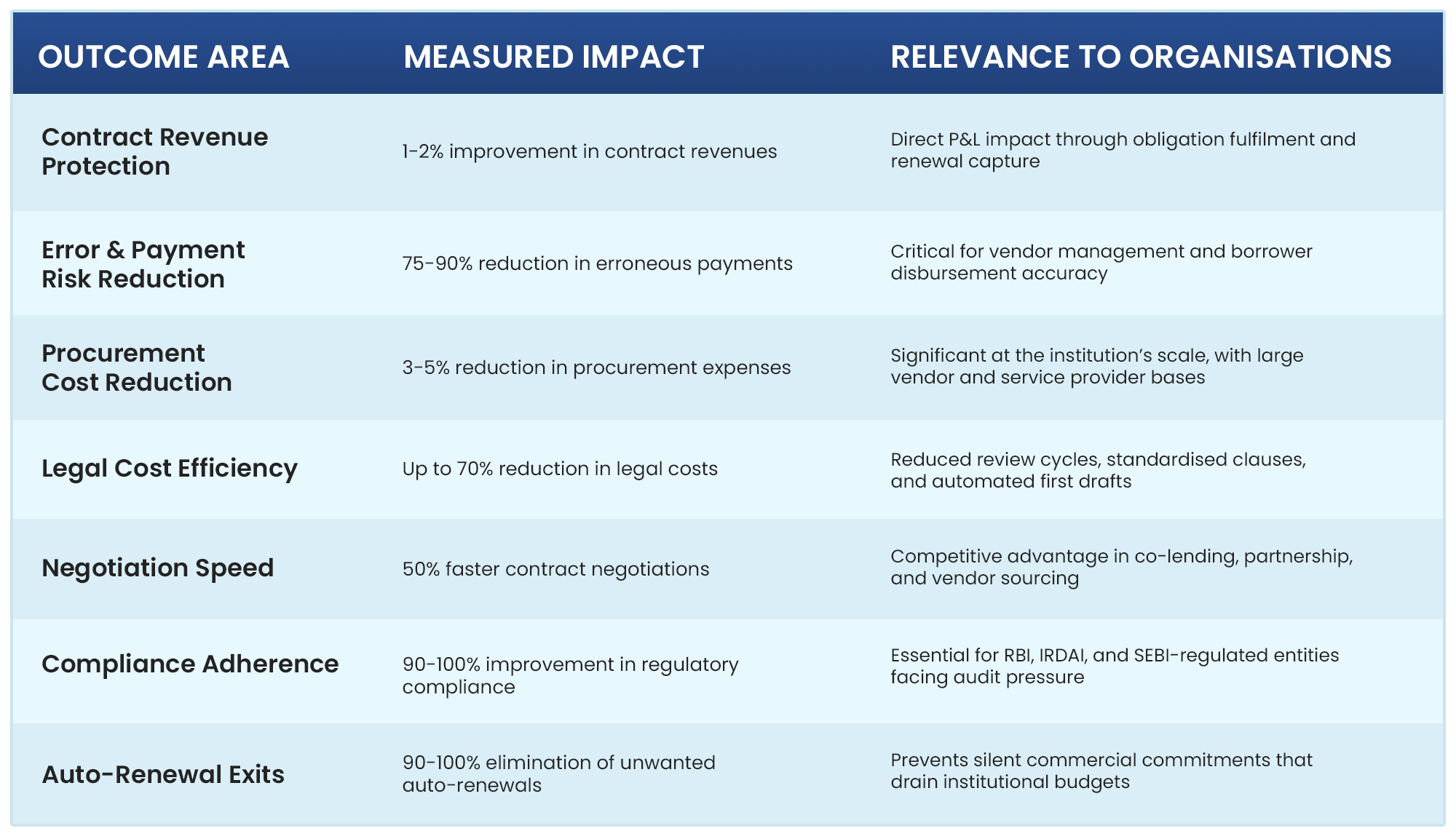
Quantifying the Business Case: What Jupitice’s CLM Delivers
The operational and financial returns from deploying Jupitice’s CLM are measurable and well-documented across enterprise deployments globally.
What Makes Jupitice CLM the Right Choice for Your Institution
India’s regulatory landscape demands a CLM platform built for complexity, not adapted to it. Jupitice CLM delivers configurable clause libraries, approval workflows, and templates across jurisdictions, regulations, and business units, covering RBI master directions, IRDAI mandates, state-specific stamp duty, and GST provisions.
It integrates seamlessly with core banking platforms, LOS, CRM, and ERP systems through open APIs and prebuilt connectors (including Salesforce, SAP Ariba, and other enterprise systems), enabling real-time, bidirectional flow of contract data directly into business workflows and decision-making. Backed by ISO 27001, ISO 9001, ISO 20000, ISO 22301, and CMMI L3 certifications, with end-to-end encryption, role-based access controls, and immutable audit trails, Jupitice CLM meets the security bar that regulated institutions cannot compromise on.
The platform scales from current contract volumes to enterprise-wide deployment, cloud, on-premises, or hybrid, without rearchitecting, while its proprietary analytics engine surfaces cycle time trends, SLA breach rates, renewal pipeline value, and compliance scores in real time, without dependency on technical teams.
The Strategic Imperative: Contracts as Competitive Assets
Contracts are the structural record of every commercial relationship your institution has built, and organisations that manage them with precision are operationally stronger, legally better protected, and commercially more agile than those that don’t.
For NBFCs, faster contract finalisation is a direct revenue advantage. For banks, instant audit-readiness is a governance differentiator. For insurers, automated obligation tracking is the difference between proactive risk management and reactive damage control. For BFSIs, speed, compliance, and control are not competing priorities; Jupitice’s CLM is designed to help deliver these three priorities simultaneously.
The question for leadership is not whether Jupitice AI-powered CLM is ready for organisations. It is whether your organisation is ready to stop treating contract management as a back-office function and start leveraging it as a front-line competitive capability.